
Every plant has one.
The job nobody volunteers for. Loud, dusty, hot, repetitive, and physically punishing by hour three.
It is usually grinding.
It is also usually the job where “good enough” varies by operator, by shift, and by how long they have been standing there.
That combination, hard on people and hard to keep consistent, is exactly what robotic grinding systems are built to solve.
What Is a Robotic Grinding System?
A robotic grinding system is an automated finishing cell where a robot applies a grinding, sanding, deburring, or polishing tool to a part along a programmed path, with controlled force and consistent speed, inside a contained and ventilated enclosure.
The important word is controlled. A robot moving a grinder along a path is not enough on its own. Material removal depends on how hard the tool presses, how fast it travels, and how worn the abrasive is. A production-grade grinding cell manages all three.
A complete system generally includes:
- The robot and end effector, either a tool on the robot or a part held by the robot against a fixed tool
- Force compliance, an active or passive device that maintains consistent contact pressure as the part surface varies
- Tool changing and wear compensation, so the program adjusts as the abrasive wears down
- Fixturing that locates the part repeatably and holds it against grinding loads
- Dust and fume extraction sized for the material being removed
- Guarding and safety systems rated for the debris and energy involved
Why Manual Grinding Is So Hard to Keep Consistent
Manual grinding is a skill, and skilled grinders are genuinely good at it. The problem is not capability. It is variability.
Fatigue changes the output. Contact pressure at hour one is not contact pressure at hour six. Neither is dwell time on a stubborn burr. Nobody decides to grind differently late in a shift, but the parts show it.
Judgment is not transferable. Your best operator knows what a finished edge should feel like. That knowledge does not transfer to a new hire in a week, and it walks out the door with them at retirement.
Inspection is subjective. Surface finish and edge break are often checked by eye and by feel. Two inspectors, two answers, and a customer complaint that nobody can reproduce internally.
A robot does not get tired, does not vary contact pressure, and produces a finish that is measurable and repeatable across the run. That is the entire value proposition, and it is a quality argument before it is a labor argument.
The Safety Case That Rarely Makes the CapEx Request
Grinding and deburring concentrate several occupational hazards into one workstation. Any one of them is manageable with PPE and process controls. Stacked together, on a job someone performs for eight hours a day, they add up.
- Respirable dust, including crystalline silica from certain castings and abrasives, which OSHA regulates under 29 CFR 1910.1053 with specific exposure limits and control requirements
- Hand-arm vibration, a documented contributor to long-term nerve and circulatory damage in operators who use vibrating tools daily
- Noise exposure that frequently requires hearing conservation programs
- Sparks, hot debris, and eye injury risk, the most common source of first aid visits at these stations
- Repetitive strain and awkward postures, especially on large or heavy parts
Automating the station does not eliminate these hazards, but it removes the person from the middle of them and moves the exposure into a contained, ventilated enclosure.
There is a workforce argument here too. The grinding booth is where new hires quit. Removing it from your staffing plan is worth real money in a market where every plant is competing for the same operators.
Where Robotic Laser Cutting Fits
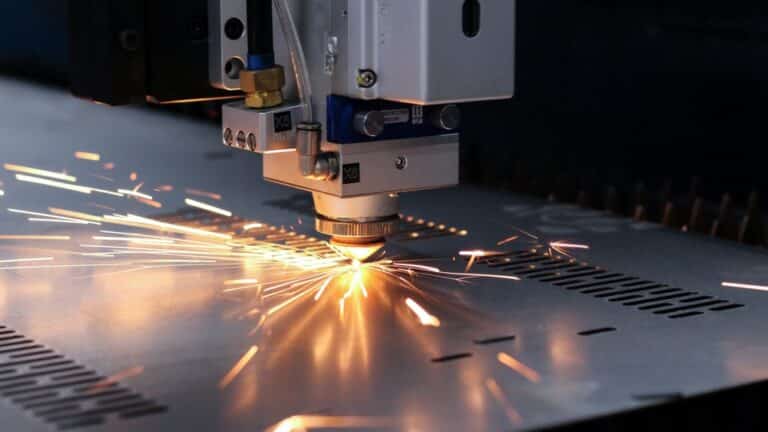
Robotic laser cutting systems solve a related but distinct problem: cutting complex profiles and three-dimensional geometries that a flat-bed laser or a manual process cannot handle well.
A robot-mounted laser head can follow contours across a formed part, trim excess material from a stamping or molding, cut holes and slots at angles, and do it to the same tolerance on part one and part ten thousand.
Where it earns its place:
- 3D trimming on formed, stamped, hydroformed, or molded parts
- Complex profiles that would require multiple fixtures or setups if done conventionally
- Low-force cutting on parts too thin or delicate for mechanical trimming
- Mixed-part production, where changing the cut means loading a different program rather than building different tooling
Like grinding, the robot is the visible part and the integration is the hard part. The fixturing, the fume extraction, the laser safety enclosure and interlocks, and the controls that tie it all together are what determine whether the cell runs production or sits idle waiting for a technician.
Is Your Process a Good Candidate?
Four questions worth answering before you scope a project.
Is the part geometry consistent enough to program?
Robotic finishing works best when incoming parts are dimensionally predictable. Highly variable castings can still be automated, but they usually need force compliance, adaptive control, or vision to locate the actual surface rather than the assumed one. That is a design decision, and it needs to happen before the quote, not after.
How is the finish specified and measured?
If your finish standard is “looks right,” automation forces a useful conversation. A robotic cell needs a measurable target: surface roughness, edge break dimension, or a defined visual standard. Plants that go through this exercise often find their real quality problem was an undefined spec.
What is the volume and mix?
High volume on a small number of parts is the easiest case. High mix is very doable, but it changes the design: quick-change fixturing, multiple stored programs, and part identification at load all need to be in scope from the start.
What is the current job actually costing you?
Include the parts of it that never make the spreadsheet. Rework from inconsistent finishes. First aid visits and workers’ compensation exposure. Turnover and retraining on a station nobody wants. PPE and hearing conservation program overhead. The fully-burdened labor number is only the beginning.
How Force Design Builds Finishing and Cutting Cells
Force Design is a custom robotic systems integrator in Troy, Ohio, and custom is the operative word on this kind of project. Grinding and laser cutting cells rarely map to a catalog configuration, because the tooling, the fixturing, and the extraction all depend on your specific part and your specific material.
Our team designs the mechanical, the controls, and the safety systems in-house. That matters here more than on most projects. Force compliance, fixture design, and dust extraction all interact, and getting them right requires the people responsible for each to be solving the problem together instead of sequentially.
We also build the data layer in from the start, the same way we do on welding and inspection systems. Cycle time per part, tool change intervals, and fault patterns are all worth logging, because on a finishing cell, tool wear is the variable that quietly changes your output.
You can see the range of what we build on our custom automation solutions page.
Run the Numbers on Your Grinding Station
Grinding is one of the few applications where the safety case, the quality case, and the labor case all point the same direction. That usually means the payback math is better than people expect.
The Force Design ROI Calculator covers fully-burdened labor, scrap and rework, downtime, and safety costs, and produces a five-year projection with a payback period you can bring to a budget conversation. It takes about five minutes.
If grinding is a bottleneck or a safety concern on your line right now, let us take a look at it. We will tell you honestly whether it is a good automation candidate, including when the answer is not yet.
Frequently Asked Questions
What is robotic grinding used for in manufacturing?
Robotic grinding is used for deburring, weld dressing, surface finishing, polishing, edge breaking, and gate or flash removal on castings and moldings. It fits best where the task is repetitive, the finish spec is measurable, and manual work produces inconsistent results or safety exposure.
Can a robot maintain consistent pressure on an uneven part?
Yes, with force compliance. Active or passive compliance devices let the tool maintain a target contact force even as the part surface varies, which is what makes robotic grinding viable on castings and welded assemblies rather than only on precision-machined parts.
Is robotic laser cutting better than a flat-bed laser?
They solve different problems. A flat-bed laser is more efficient for cutting flat sheet. A robotic laser cutting system is the right choice for three-dimensional parts, formed geometries, angled features, and trimming operations where the cut path is not on a single plane.
Does automating grinding eliminate the need for PPE?
No, but it changes the exposure. A properly enclosed and ventilated cell contains dust, sparks, and noise, and removes the operator from continuous contact with the hazard. PPE requirements still apply for loading, maintenance, and tool changes, and every cell needs its own risk assessment.
How long does a robotic grinding project take?
Timelines vary with complexity, tooling lead times, and how well the part and finish spec are defined at the start. The single biggest schedule variable is usually clarity on the finish standard, which is why we push that conversation to the front of the project.
Force Design Inc. is a custom robotic systems integrator based in Troy, Ohio, with 25+ years of experience designing and building welding, finishing, assembly, packaging, and material handling automation for manufacturers in automotive, food and beverage, medical, and general manufacturing.