
Upstream, everything runs.
The process is dialed in, the machines are fast, the quality numbers are good.
Then product reaches the end of the line, and three people start stacking boxes by hand.
That is where the throughput you paid for goes.
What Is End of Line Packaging Automation?
End of line packaging automation refers to the automated systems that handle product after it is manufactured: filling, bagging, sealing, labeling, case packing, stacking, palletizing, depalletizing, and preparing loads for the dock.
It is the least glamorous section of the plant and often the most expensive one to leave manual, because everything upstream is limited by how fast the end of the line can clear product.
Common end-of-line systems include:
- Case packing and cartoning, loading product into boxes or trays
- Bagging and bag handling, including automated bag placement, filling, and closing
- Robotic palletizing, building pallet loads to a defined pattern
- Robotic depalletizing, breaking down incoming pallets for processing
- Labeling and marking, applied consistently and tied to traceability data
- Conveyance and accumulation, the buffering that keeps upstream equipment from starving or blocking
Why the End of the Line Is Where Throughput Disappears
A production line runs at the speed of its slowest station. When that station is manual packing or palletizing, the constraint is a person, and people have a hard ceiling.
The symptoms are recognizable.
Upstream equipment idles. Your expensive machine center waits because product cannot clear fast enough. You are paying depreciation on capacity you cannot use.
Overtime absorbs the gap. Rather than fixing the constraint, the schedule stretches. That is a recurring cost that never appears as a capital request, so it never gets scrutinized the way an equipment purchase would.
Turnover concentrates here. Manual palletizing is heavy, repetitive lifting. It is where back injuries happen and where new hires decide the job is not for them. Every departure costs recruiting, training, and a temporary productivity dip.
Quality gets inconsistent at the worst possible moment. Mislabeled cases, wrong pallet counts, and damaged product all happen at the very end, after you have already spent everything it cost to make the product correctly.
Here is the part that gets missed in the CapEx conversation: none of these show up as one line item. They show up as slightly more overtime, slightly higher turnover, slightly more damaged product, spread across four different cost centers.
What a Robotic Depalletizing System Actually Solves
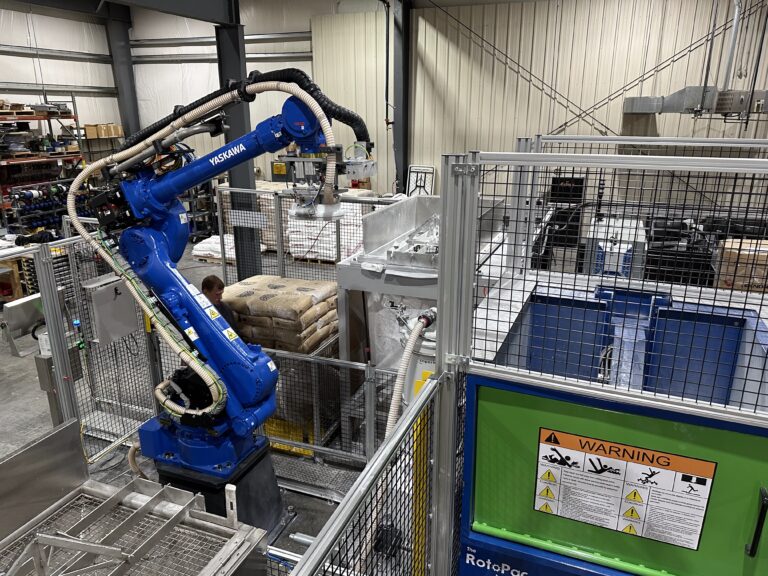
A robotic depalletizing system uses a robot with a purpose-built end-of-arm tool to remove product from incoming pallets and feed it into your process, in a controlled sequence, without a person lifting each unit.
It is the mirror image of palletizing and it tends to be the harder of the two, because incoming pallets are rarely as consistent as the ones you build yourself. Bags shift. Layers lean. Supplier patterns vary. Wrap and slip sheets have to be dealt with.
That is why the tooling and the sensing matter more than the robot. A depalletizing cell needs to handle the pallet it actually receives, not the pallet on the spec sheet.
The results, when it is engineered correctly, are straightforward. When Scoular automated their bagging operation with Force Design, throughput went from 5 bags per minute to 12 to 13 bags per minute with the same crew. No new hires, no added shift. The end of the line simply stopped being the constraint.
You can see the system on our Robotic Depalletizer and Bag Dumping project page, along with the Robotic Depalletizer Cell and Automated Coiling and Packaging Line we built for other end-of-line applications.
What to Define Before You Get a Quote
End-of-line projects go sideways for predictable reasons, and almost all of them are scope questions that should have been answered earlier.
What is the real rate, including the bad days?
Quote to your peak sustained rate, not your average. A cell sized to your average will become the new bottleneck on your busiest week, which is exactly when it costs you most.
How many SKUs, and how different are they?
Pack pattern, case size, bag dimensions, and weight all drive tooling. A cell handling three similar cases is a different machine than one handling fifteen sizes across two product families. Both are buildable. They are not the same budget.
What is your actual footprint, including access?
Floor space is the obvious constraint. The ones that surprise people are ceiling height, column locations, forklift traffic patterns, pallet staging area, and maintenance access. Measure before you design.
What happens when a bag tears or a case jams?
Every end-of-line system faults eventually. The question is whether recovery takes 30 seconds by an operator or 30 minutes by a technician. That is a design decision, and it deserves as much attention as the cycle time.
Who handles integration with your existing conveyance?
The new cell has to talk to what is already there. Ask specifically who owns the handoff points, the controls integration, and the safety interlocking across the boundary. If the answer involves more than one company, expect finger-pointing.
How Force Design Approaches End of Line
Force Design has been building end-of-line packaging automation and robotic depalletizing solutions for 25 years out of Troy, Ohio, for food and beverage, consumer products, packaging, and general manufacturing.
We build custom, which on end-of-line projects is less a philosophy than a practical necessity. Your product, your pallet pattern, your dock, and your existing conveyance are specific to you. Force-fitting a catalog machine into that reality is how plants end up with equipment that runs at 70 percent of its rated speed forever.
Our mechanical designers, controls engineers, and applications engineers are in one building. When the end-of-arm tool design affects the cycle time, which it always does, the people responsible for both are already in the same conversation.
And we do not disappear after installation. Ongoing support is one of the reasons clients like Teknor Apex and Superior Plastics describe the relationship as a partnership rather than a transaction.
Find Out What the End of Your Line Is Costing You
Most manufacturers underestimate the fully-burdened cost of their manual end-of-line operation by a wide margin, because the cost is spread across labor, overtime, damage, and turnover instead of sitting in one place.
The Force Design ROI Calculator pulls those numbers into one view: fully-burdened labor, downtime, scrap and damage, and a five-year projection with a payback period. Five minutes, no sales call.
If you want to think through the options before you talk to anyone, our ebook How to Automate Packaging walks through the decisions in order.
Ready to fix the end of your line? Let us talk about it.
Frequently Asked Questions
What is the difference between palletizing and depalletizing?
Palletizing builds a pallet load by stacking product in a defined pattern for shipping or storage. Depalletizing does the reverse, removing product from an incoming pallet and feeding it into a process. Depalletizing is usually the harder engineering problem, because incoming pallets are less consistent than the ones you build yourself.
How much throughput can end of line packaging automation add?
It depends entirely on what the manual constraint is. In one Force Design food and beverage project, automated bagging took throughput from 5 bags per minute to 12 to 13 with the same crew. The right question is not what the industry average gain is, but what your specific bottleneck is costing you today.
Can a robotic depalletizing system handle multiple products and pallet patterns?
Yes, when it is designed for it. Multiple pallet patterns are handled through stored programs, vision or sensing to verify layer position, and tooling capable of gripping the range of products involved. The mix needs to be defined during design, because it drives the end-of-arm tool more than any other factor.
Is end of line automation only for high-volume plants?
No. Volume helps the math, but the strongest cases often come from lower-volume plants where the end-of-line job is physically demanding, hard to staff, or a chronic source of injuries and turnover. Those costs are real even when the unit count is modest.
What is a typical payback period on packaging automation?
Many end-of-line projects land under 24 months once fully-burdened labor, overtime, product damage, and turnover costs are included. The variable that moves it most is shift structure, since a system running two or three shifts pays back roughly twice as fast as one running a single shift.
Force Design Inc. is a custom robotic systems integrator based in Troy, Ohio, with 25+ years of experience designing and building packaging, palletizing, welding, assembly, and material handling automation for manufacturers in automotive, food and beverage, medical, and general manufacturing.