
The reject report lands at 4:30.
Twelve parts flagged, all from the same station, all inside the same three-hour window.
By the time anyone reads it, the shift is over and the parts are already downstream.
The welds looked fine at the station. They just weren’t.
A robotic welding cell will not prevent every quality problem. But a robotic welding cell that logs every weld will tell you about one while you can still do something about it.
What Is a Robotic Welding Cell?
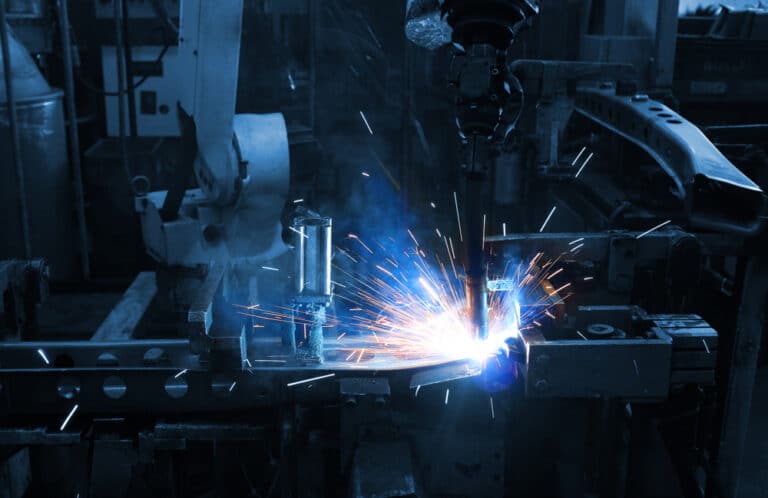
A robotic welding cell is a self-contained welding station that combines a welding robot, part fixturing, a power source, a safety enclosure or laser-scanned perimeter, and the controls that sequence all of it into one repeatable process.
The robot is one component. The cell is the system that makes the robot repeatable.
A complete cell typically includes:
- The robot and torch package, sized to the reach, payload, and duty cycle of your parts
- Fixturing that locates and clamps the part the same way every cycle
- Part handling, whether that is a positioner, a turntable, a shuttle, or an operator load station
- The weld power source and process parameters tuned to your material and joint design
- Safety systems, including guarding, interlocks, light curtains or scanners, and fume extraction
- Controls and data, the PLC logic and logging layer that sequences the cell and records what happened
Miss any one of those and you do not have a cell. You have a robot that welds sometimes.
Why “A Robot With a Torch” Falls Short
Most welding automation disappointments trace back to the same root cause. The robot was the easy part, and everything around it was treated as an afterthought.
Here is what that looks like in practice.
Fixturing that lets the part move. A robot repeats its programmed path to a fraction of a millimeter. If the part is not in exactly the same place every cycle, that precision works against you. The robot welds precisely to the wrong location. Manual welders compensate for part variation without even noticing. A robot cannot.
Sequencing built around the robot instead of the line. A cell that welds a part in 90 seconds but takes 3 minutes to load and unload has not solved a throughput problem. It has moved it.
No data layer. The cell runs, parts come out, and the only record of what happened is whether an operator hit reset. When a quality issue surfaces two weeks later, there is nothing to trace it back to.
That last one is the quiet one, and it is the difference between a welding cell that improves your quality numbers and one that just moves the labor around.
What “Logging Every Weld” Actually Means
Weld data logging means the cell captures a record for every pass on every part, tied to a part identifier, and stores it somewhere a person can actually review.
A well-instrumented robotic welding cell records:
- Arc-on time and arc starts per part, so a missed or short weld is visible immediately
- Weld parameters per pass, including voltage, current, wire feed speed, and travel speed
- Fault codes with timestamps, not just the fact that someone cleared a fault
- Cycle time per station, which is where creeping mechanical problems announce themselves first
- Part ID tied to the weld record, through marking, serialization, or barcode at load
- Downstream inspection results, when vision or leak testing is integrated into the same data stream
The value is not the dashboard. The value is that a pattern of small deviations becomes visible before it becomes a scrap report.
A cell that logs 47 faults in the same sequence over two hours is telling you something specific. A cell that only logs “operator reset” is telling you nothing.
Where Traceability Pays for Itself
Warranty and recall exposure. When a field failure traces back to a weld, the question your customer asks is which parts are affected. Without per-part weld records, the honest answer is often “we are not sure,” and the expensive answer is a wider containment than you actually need.
Scrap and rework. Catching a parameter drift in hour two instead of hour eight is the difference between a handful of reworked parts and a full shift of them.
Customer audits. Automotive Tier 1 suppliers already live inside PPAP and IATF 16949 documentation requirements. A cell that produces its own weld records turns an audit scramble into a report you export.
Preventive maintenance. Cycle-time creep, rising fault frequency, and consumable wear patterns are all visible in the data long before anything actually breaks.
What to Look For Before You Commit
Before you sign for a welding cell, get straight answers to four questions.
Who owns the fixture design?
If the integrator is quoting the robot and expecting you to supply fixturing, you are the systems integrator now. Ask who is responsible when a part does not locate correctly, and make sure the answer is one company.
Where does the weld data go?
Ask specifically: what is captured, in what format, where is it stored, and who can pull a report without calling the integrator? Retrofitting data visibility onto a cell that was not built for it is expensive and usually incomplete. Specify it during design.
What happens when the part changes?
Almost every part changes eventually. Ask what a new part number costs in reprogramming, tooling, and downtime, and whether your team can handle it or whether every revision means a service call.
Who answers the phone in year three?
The install is the beginning of the relationship, not the end of it. Ask about support response times, spare parts, and whether the people who built the cell are still the people who support it.
How Force Design Approaches Welding Cells
Force Design has built welding systems for 25 years out of one shop in Troy, Ohio, including MIG welding cells, ultrasonic welders, projection nut welders, and robotic weld fixtures across automotive and general manufacturing. Welding is our single largest portfolio category.
That experience shows up in the parts of the cell nobody photographs. The Automotive Robotic Welding Cell we built for a Tier 1 supplier integrates fixturing, part handling, and weld sequencing into one station engineered around that customer’s specific parts. The Flexible Welding Cell was designed for a plant running multiple part numbers through the same station without a full retool. The Large Robotic Welding Cell handles parts that would not fit a catalog solution at all.
Our mechanical designers, controls engineers, and applications engineers work in the same building. When the fixture design affects the weld sequence, which it always does, that conversation happens down the hall instead of across three vendors.
That is the part our team calls craftsmanship. It is also just what it takes to make a cell run shift after shift.
Start With Your Numbers
If you are weighing a welding cell against another year of manual welding, the case gets made on your numbers, not on general industry claims.
The Force Design ROI Calculator walks through fully-burdened labor cost, scrap and rework, downtime, and payback period in about five minutes, and generates a projection you can put in front of your finance team. No sales call required.
If you are earlier than that and still scoping the project, our ebook Robotic Welding Systems Part 1: Planning covers what to define before you request a single quote.
And if you would rather just talk it through, contact us. Twenty minutes with an engineer who has built this before is usually worth more than another round of research.
Frequently Asked Questions
What is the difference between a robotic welding cell and a robotic welding system?
The terms overlap in everyday use. In practice, a robotic welding cell refers to one self-contained station: robot, fixturing, power source, safety, and controls. A robotic welding system can describe a single cell or a larger arrangement of multiple cells and material handling working together as one process.
Can a robotic welding cell handle more than one part number?
Yes. Flexible cells are designed for it, using quick-change fixturing, multiple stored weld programs, and part identification at load. The tradeoff is upfront engineering: a cell designed for changeover from day one costs less than one retrofitted for it later.
How does weld data logging improve quality?
It shifts quality control from reactive to proactive. Instead of finding out about a problem from an end-of-shift reject report, per-weld data surfaces parameter drift, fault patterns, and cycle-time changes while production is still running, when a correction still prevents scrap.
Does a robotic welding cell replace welders?
It changes what your welders do. The cell handles repetitive production passes. Your experienced welders move to setup, programming, quality oversight, fixture work, and the complex jobs that actually require their judgment. In a market where skilled welders are hard to hire and harder to keep, that is a retention strategy as much as a throughput one.
What is a realistic payback period for a robotic welding cell?
It depends on shift structure, labor cost, scrap rate, and throughput gain. Many manufacturers land under 24 months once fully-burdened labor is calculated correctly. Run your own numbers with the ROI Calculator rather than relying on an industry average.
Force Design Inc. is a custom robotic systems integrator based in Troy, Ohio, with 25+ years of experience designing and building welding, assembly, packaging, and material handling automation for manufacturers in automotive, food and beverage, medical, and general manufacturing.