
If you’ve been holding off on automation because you’re worried about what it means for your people, you’re asking the wrong question.
The real question isn’t “will automation replace my workforce?” It’s “what is my workforce capable of when you remove the work that’s slowing them down?”
That reframe matters, especially right now, when skilled labor is harder to find and harder to keep than at any point in recent memory. The manufacturers who are winning aren’t the ones with the most headcount. They’re the ones who figured out how to make every person on their team count more.
That’s what automation as a workforce multiplier looks like in practice.
Why the Labor Shortage Isn’t a Hiring Problem: It’s a Throughput Problem
The instinct when you’re short-staffed is to hire. But in today’s manufacturing environment, hiring your way out of a capacity problem is expensive, slow, and increasingly unreliable.
Skilled trades positions in U.S. manufacturing have been hard to fill for years. The pipeline of experienced operators, welders, and machine tenders isn’t growing fast enough to match demand, and turnover compounds the problem. Every time a trained employee walks out the door, you lose not just the headcount but the institutional knowledge they carried with them.
The throughput ceiling isn’t just about how many people you have. It’s about what those people can realistically produce given the manual processes, repetitive tasks, and inefficiencies built into the line. When you automate the right tasks, you lift that ceiling, often dramatically, without adding a single hire.
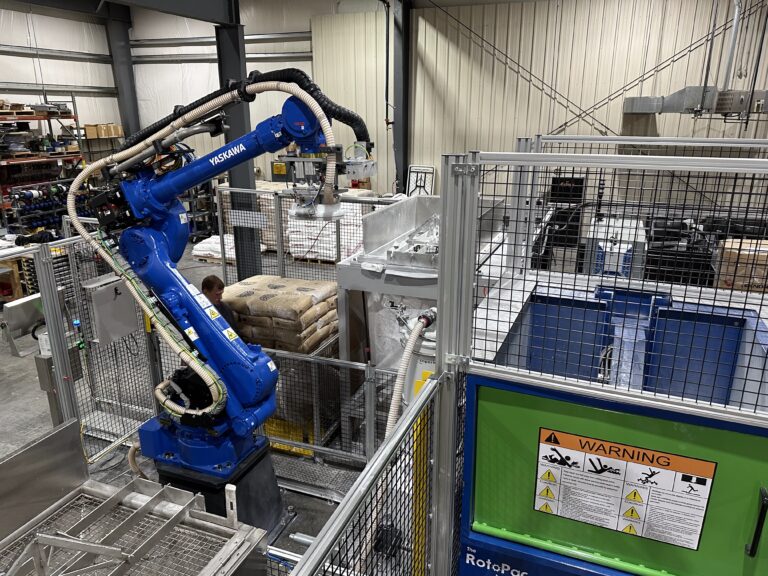
The Scoular example illustrates this well. After Force Design implemented an automated bagging system, their production went from 5 bags per minute to 12-13 bags per minute, a 2.4x increase in throughput, with the same crew. No new hires. No overtime. Just the existing team, freed up to operate at a level the manual process never allowed.
What “Workforce Multiplier” Actually Means on the Floor
The term gets used a lot. Here’s what it means in concrete terms.
A workforce multiplier is any system or process change that increases the output or impact of each person already on your team. In manufacturing, automation is the most reliable multiplier available.
When you automate a repetitive task, like loading parts, running welds, or palletizing product, you don’t eliminate the need for people. You redirect people toward higher-value work: quality oversight, machine monitoring, process improvement, and problem-solving. Work that actually requires human judgment.
This has two effects that compound over time. First, throughput goes up because the automated system runs faster and more consistently than the manual process. Second, employee satisfaction tends to improve because your best people aren’t grinding through work that doesn’t challenge them. That combination is how you retain talent in a tight labor market.
How to Identify Which Tasks Are Stealing Capacity from Your Best People
Not every task on your floor is a good automation candidate. The goal is to identify work that is high in repetition, low in variability, and physically taxing or mentally numbing, then replace it with something your people don’t have to think about.
A few questions to help you find the right targets:
Which tasks generate the most operator fatigue or injury risk? These are usually strong automation candidates. If a task is physically demanding and repeated hundreds of times per shift, it’s also a turnover driver.
Where does your line stop most often, and why? Bottlenecks caused by manual throughput limits are exactly the kind of constraint automation removes.
What does your best operator do that your newest operator can’t? If the answer is “nothing, it’s all just repetition,” that task belongs in an automated cell. Your best people should be doing work that requires skill.
Where do quality issues originate? Manual processes introduce variability. If scrap or rework is concentrated in one part of the line, that’s often a signal that automation can deliver more consistent output.
The answers to these questions usually point to a short list of high-impact opportunities and a clear financial case for moving on them.
The Cost of Doing Nothing
Here’s what the workforce multiplier math looks like when you don’t act.
Labor costs inflate. The fully-burdened cost of an employee, including base salary, benefits, HR overhead, training, and turnover, typically runs 1.4x or more above base pay. As wages rise and turnover increases, that cost climbs every year.
Meanwhile, your output stays flat. You’re paying more for the same throughput, and competitors who have automated are widening the gap.
The manufacturers who delay automation decisions often frame it as conservatism. In practice, it’s a slow accumulation of competitive disadvantage that becomes harder to close the longer it compounds.
What This Looks Like with Force Design
Force Design’s approach has always started with the human problem, not the machine spec. When we scope an automation project, we’re asking what your team could be doing if we took this task off their plate, not just what the robot will do.
That’s a different conversation than you’ll have with a vendor who leads with catalog options. It’s also why clients like Teknor Apex, Superior Plastics, and Scoular describe their relationship with Force Design as a partnership rather than a transaction.
See How Much Capacity You Could Unlock
If you’ve been thinking about automation but haven’t put real numbers to it, our free ROI Calculator is the place to start. It walks you through labor costs, throughput gains, and payback period so you can walk into any internal conversation with a clear financial picture.
Run your numbers here: https://roi.forcedesign.biz/
Frequently Asked Questions
Does automation really help with workforce shortages in manufacturing? Yes. Automation addresses workforce shortages not by eliminating jobs, but by increasing what each existing employee can produce. When repetitive, high-volume tasks are automated, your current team can focus on higher-value work and effectively multiply their output without requiring new hires.
What types of manufacturing tasks are best suited for automation? The strongest candidates are tasks that are repetitive, physically demanding, low in variability, and a source of operator fatigue or quality inconsistency. Common examples include material handling, palletizing, welding, machine tending, and end-of-line packaging.
How long does it take to see ROI from manufacturing automation? Payback periods vary by project, but sub-24-month payback is achievable for many systems when you account for fully-burdened labor costs, throughput gains, reduced scrap, and lower downtime. Use the Force Design ROI Calculator to model your specific situation.
Will automation hurt employee morale? In most cases, the opposite is true. Removing repetitive, physically taxing work tends to improve employee satisfaction and retention. Workers reassigned to monitoring, quality, or process improvement roles consistently report higher job satisfaction than those performing manual line work.